
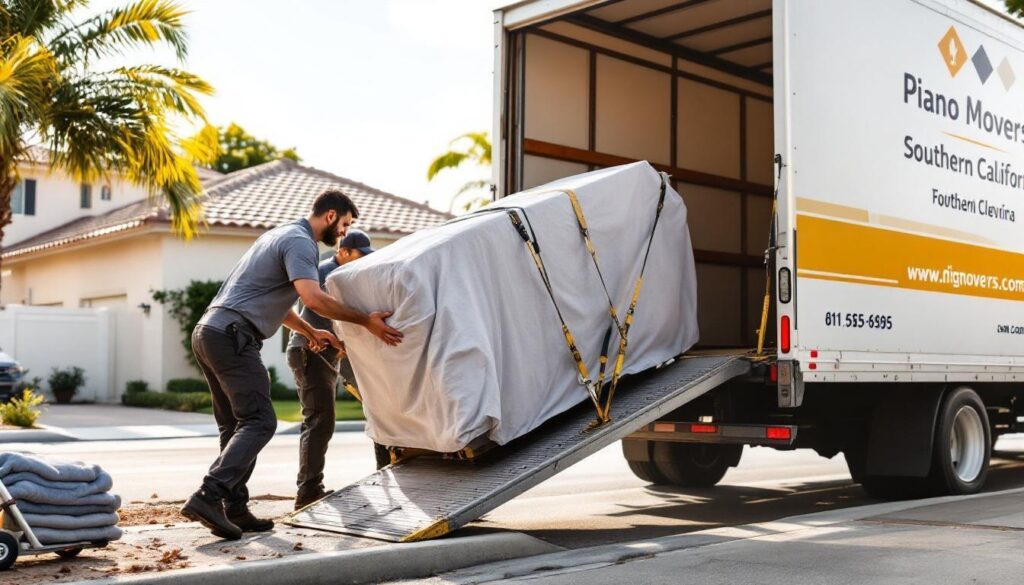
Moving a piano across Southern California isn’t like moving a couch. These instruments demand specialized knowledge, equipment, and care that most standard moving companies simply don’t have.
At Southbay Moving Systems, we’ve seen too many pianos damaged by movers who underestimated the complexity involved. The right piano movers Southern California can protect your investment and get your instrument to its new home in perfect condition.
Why Piano Moving Requires Specialized Expertise
A Baldwin upright piano weighs around 400 to 500 pounds, while a Steinway baby grand can tip the scales at 700 to 900 pounds. A concert grand piano exceeds 1,200 pounds. These numbers define the structural challenge of moving a piano safely. Standard movers equipped with basic dollies and furniture pads treat a piano move like any other household item, which is where damage happens. Pianos contain thousands of precisely calibrated internal parts. The soundboard alone is a thin, engineered piece of spruce that cracks under improper handling. When a piano shifts in a truck, even slightly, those internal hammers, strings, and action mechanisms misalign. A piano that played beautifully before the move may produce dead notes or inconsistent tone afterward. Repairing this kind of internal damage costs $300 to $500 in regulation work, and that’s assuming the soundboard didn’t crack, which would demand expensive refinishing.
Uneven Weight Distribution Demands Proper Equipment
The weight of a piano isn’t distributed evenly. The keyboard end is lighter, while the back and legs carry most of the load. A standard furniture dolly collapses under this uneven pressure. Piano-specific equipment includes four-wheel dollies rated for 1,500 pounds or more, hump straps that secure the instrument horizontally, and piano boards that distribute weight across the entire base. Stairs multiply the complexity exponentially. Moving an upright piano up a single flight of stairs adds $40 to $100 to the final bill because crews must use ramps, skid boards, and additional personnel to control descent and prevent tipping.
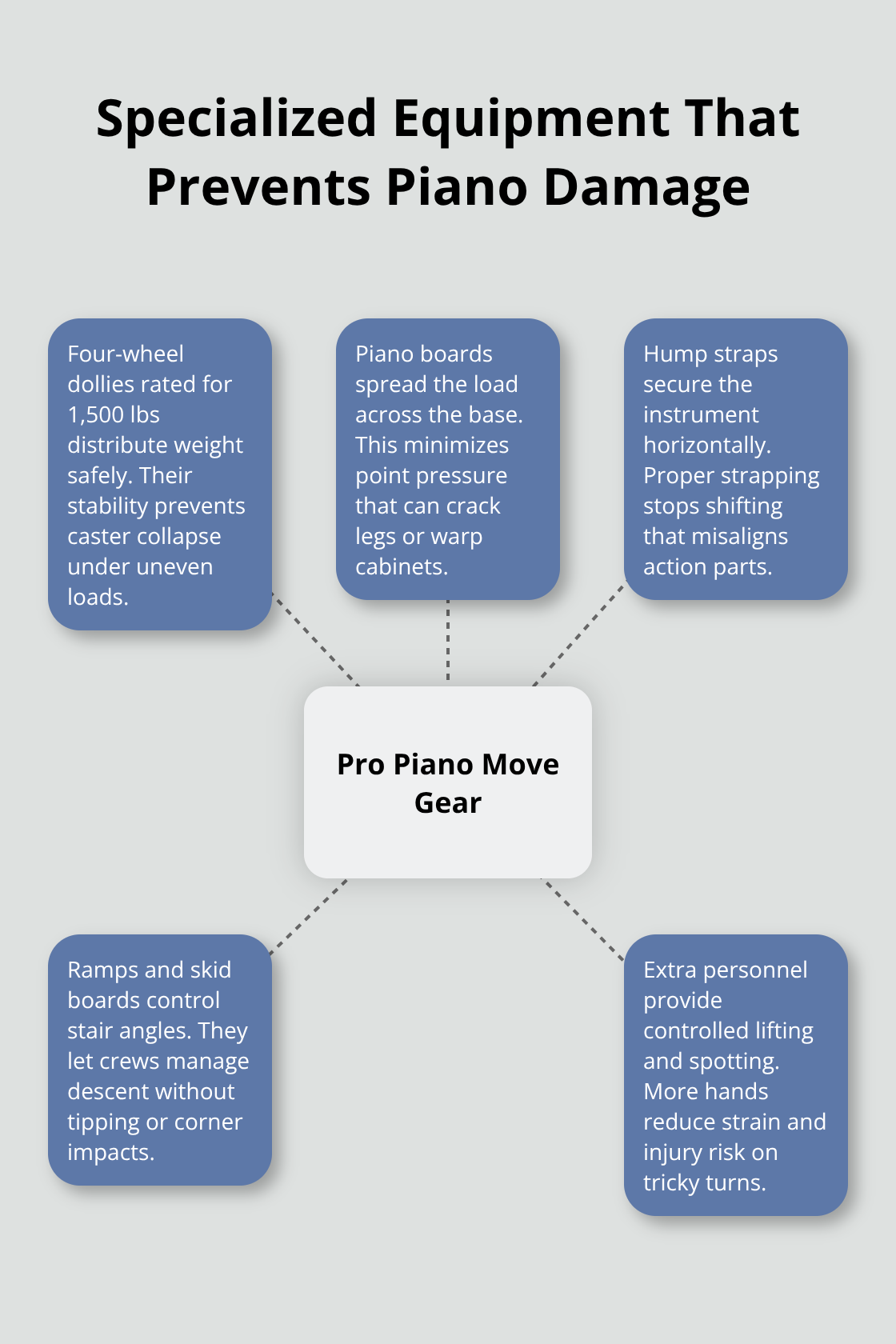
A tight hallway turn adds another $25 to $80. These aren’t inflated charges-they reflect the genuine difficulty and injury risk involved. Without specialized equipment, movers resort to tilting the piano on its corner, a practice that damages legs, warps the cabinet, and risks internal component misalignment.
Temperature and Humidity Shifts Affect Tuning Stability
Temperature and humidity swings destroy piano tuning. When a piano moves from a climate-controlled home to a truck exposed to Southern California heat, the wood expands and contracts. Soundboard swells, changing string tension and pitch. Post-move tuning typically costs $125 to $225, but if the climate change is severe-say, from a humid coastal area to a dry inland region-regulation costs spike to $300 or $500. Professional piano movers use climate-controlled trucks that maintain stable temperature and humidity during transit, preventing the worst of this damage. General moving companies use standard cargo trucks that heat up under the sun and allow humidity to fluctuate wildly during a 100-mile Southern California move. The piano arrives out of tune and potentially with internal stress that shortens its lifespan.
Why Specialized Movers Protect Your Investment
The decision to hire specialized piano movers isn’t about luxury-it’s about protecting an instrument that represents both financial and emotional value. A piano that costs $3,000 to $10,000 new (or far more for vintage or concert instruments) deserves movers who understand its vulnerabilities. Specialized piano movers carry insurance that covers the full declared value of your instrument, typically up to $5,000 with additional coverage available at $10 to $15 per $1,000 of declared value. They arrive with equipment designed specifically for pianos, crews trained in proper handling techniques, and experience moving hundreds of instruments across Southern California. When you hire a general moving company that lacks piano experience, you assume the risk of damage that their standard liability coverage won’t fully address. The cost difference between a general mover and a piano specialist often amounts to a few hundred dollars-a small price compared to the repair bills that follow a mishandled move.
What to Expect During a Professional Piano Move
Pre-Move Assessment Determines Your Moving Strategy
The first step in a professional piano move happens before the truck arrives-a pre-move assessment where specialists visit your home to measure doorways, hallways, stairwells, and tight corners the piano must navigate. A baby grand piano measures roughly 5 to 6 feet wide and 5 feet deep. If your hallway is 3 feet wide with a 90-degree turn, that piano cannot make the corner without disassembly. This assessment determines whether the piano moves as one unit or whether the crew removes the legs and lid.
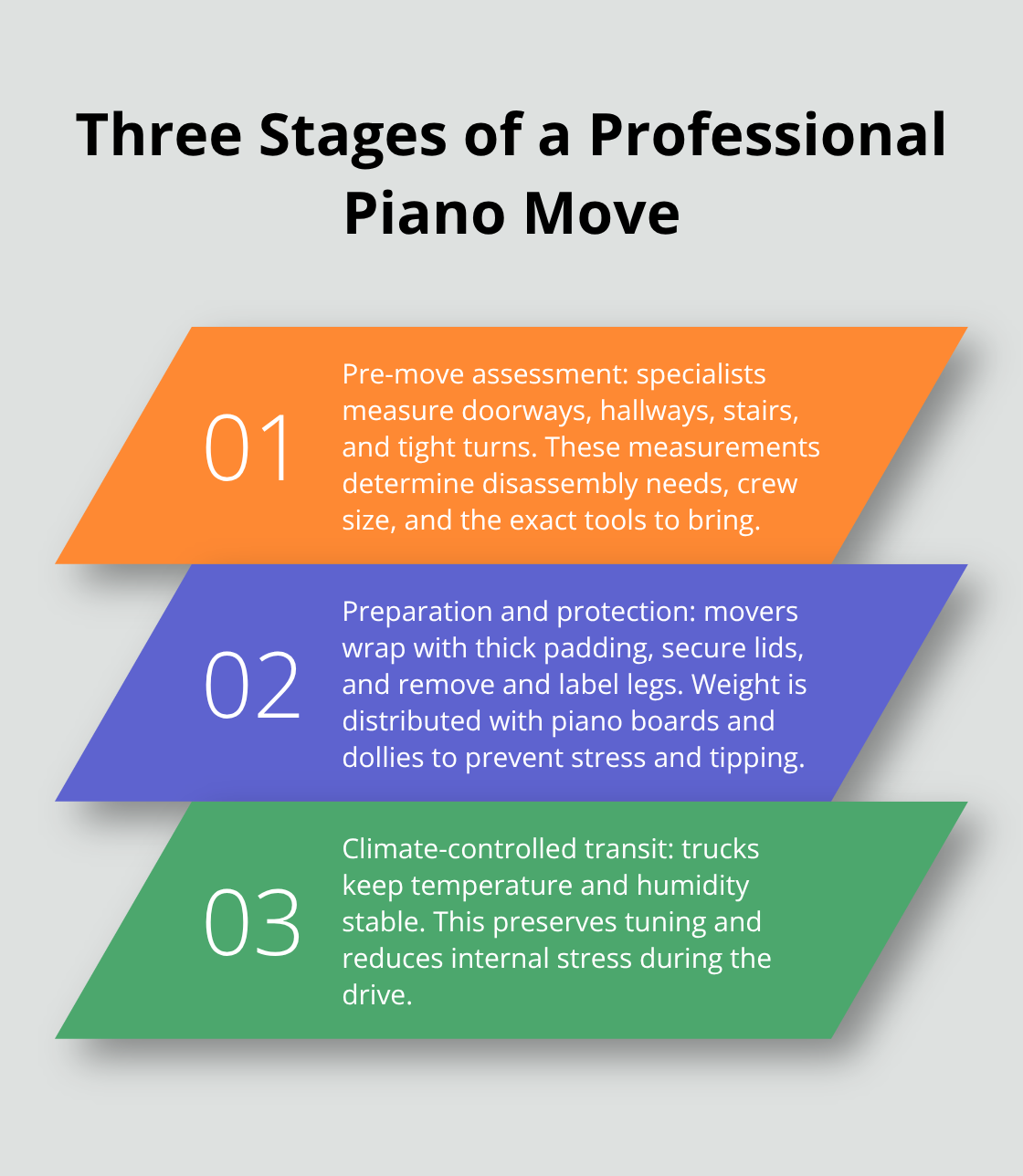
For an upright piano ascending a flight of stairs, specialists measure the stairwell width, the height of each step, and the ceiling clearance at the landing. These numbers dictate which equipment the team brings and how many personnel they need on move day. A staircase that’s too narrow forces crews to use a piano board and hump strap on an angle rather than straight, adding $40 to $100 to your cost but preventing the damage that occurs when movers improvise without proper measurement.
Specialized Padding and Equipment Protect Every Surface
Once the assessment is complete, the piano itself requires preparation. Professional movers wrap the instrument in multiple layers of specialized padding-not standard furniture blankets, but thick, quilted protective covers that cushion against impact and temperature swings during transit. The legs detach and receive labels, the lid secures in the closed position, and the entire cabinet wraps to protect the finish from scratches and dust. Specialized equipment like a four-wheeled piano dolly rated for 1,500 pounds or more distributes the weight safely. A piano board spreads that weight evenly across the base, while hump straps secure the instrument horizontally so it cannot shift during the move. For stairs, crews add a ramp and skid board to control the descent angle and prevent tipping. Inside the truck, the piano positions against a wall and receives additional straps to prevent movement during acceleration, braking, or turns.
Climate Control Maintains Tuning Stability in Transit
Climate-controlled trucks maintain stable temperature and humidity, protecting the soundboard from the expansion and contraction that occurs in standard cargo vehicles during a Southern California move. General moving companies use standard cargo vehicles that heat up under the sun and allow humidity to fluctuate wildly during a 100-mile move. The piano arrives out of tune and potentially with internal stress that shortens its lifespan. Professional movers understand that this environmental protection is not optional-it’s essential to preserving the instrument’s condition and playability after relocation.
Loading and Securing Prevents Damage in Transit
The entire process-assessment, wrapping, disassembly, loading, and securing-reflects why specialized piano movers charge what they do and why general moving companies should never attempt a piano relocation without this level of preparation. Each step protects your investment from the moment the crew enters your home until they position the piano in its new location. Understanding what happens during these stages helps you recognize the difference between a company that treats pianos as standard furniture and one that recognizes them as precision instruments requiring expert handling.
How to Spot a Trustworthy Piano Mover in Southern California
Hiring the wrong piano mover costs thousands in repairs. The Southern California market includes specialists with 4.4 to 5.0 star ratings on Yelp and hundreds of verified reviews, which signals both strong demand and established track records. Start by checking the mover’s Department of Transportation number and California Public Utilities Commission license. Sterling Los Angeles piano movers, for example, holds U.S. DOT number 1802189 and ICC MC 655329-these numbers are public and verifiable. Call the California Public Utilities Commission directly if you doubt a license claim; unlicensed operators exist and they carry no legal responsibility if your piano arrives damaged.
Verify Insurance Coverage Before You Sign
Insurance matters equally. Standard moving company policies cover up to $5,000 in piano value, but pianos worth $8,000 to $15,000 require additional coverage at $10 to $15 per $1,000 of declared value. Ask for a written insurance quote before signing any contract. A reputable mover will provide this without hesitation. General moving companies often refuse to declare full coverage, which means you absorb the loss if something goes wrong.
Check References and Online Reviews
Request references from at least three previous piano clients and actually call them. Ask specifically whether the piano arrived in tune, whether the finish showed any scratches, and whether the mover completed the job on the promised date. Online reviews on Yelp and Google matter, but they tell only part of the story. A mover with 693 reviews like Pasadena Moving Company demonstrates volume and consistency, but one negative review mentioning a cracked soundboard outweighs fifty five-star reviews praising speed.
Demand Transparent Pricing in Writing
Transparent pricing eliminates surprise charges on move day. The national median piano move costs $424, with a typical range between $259 and $589 according to industry data, but Southern California’s saturated market means rates vary widely. Request written quotes from at least three movers that break down labor, equipment, stairs, obstacles, and travel distance separately. Stairs add $5 to $10 per step or $40 to $100 per staircase; tight hallway turns add $25 to $80 each.

If a quote omits these line items, the mover either doesn’t understand the job or plans to add charges later. Ask whether the quote includes climate-controlled transport, disassembly and reassembly, padding, and dollies. Some movers advertise flat rates for upright pianos at $285 or similar fixed prices, which appeals to budget-conscious customers but often excludes stairs and obstacles that will inflate the final bill. Compare quotes side by side and reject any mover who cannot explain every charge in writing.
Schedule Your Move During Off-Peak Times
Availability also matters. Peak season in Southern California runs from May through September and especially around month-end when most moves occur. Scheduling your move in winter or mid-month saves $400 to $700 compared to peak times. A mover with fast availability during peak season may prioritize speed over care, while one willing to schedule your move for an off-peak date likely has capacity to give your piano proper attention.
Final Thoughts
Moving a piano across Southern California demands expertise that general moving companies cannot provide. The complexity of protecting a 300 to 1,200 pound instrument through doorways, up staircases, and across climate variations requires specialized knowledge, equipment, and insurance coverage. When you hire professional piano movers in Southern California, you eliminate the risk of internal damage, soundboard cracks, and tuning problems that cost hundreds or thousands to repair.
Your piano represents both financial value and personal significance, which is why the right specialists matter. Professional movers arrive with climate-controlled trucks, four-wheel dollies rated for heavy loads, and crews trained in proper disassembly and reassembly techniques. You receive written insurance coverage that protects your investment and transparent pricing that prevents surprise charges on move day.
Start your search by verifying licensing and insurance, requesting written quotes from multiple providers, and checking references from previous clients. When you’re ready to move your piano with confidence, contact Southbay Moving Systems for a free quote and experience the difference that specialized piano moving expertise makes.