

Moving company pricing varies wildly depending on what you’re moving and where you’re going. At Southbay Moving Systems, we’ve helped thousands of people understand their costs before they commit to a move.
This guide breaks down the real numbers behind moving expenses and shows you exactly what affects your final bill.
What Drives Your Moving Bill
Distance Determines Your Pricing Model
Distance is the first cost multiplier you need to understand. Local moves within about 50 miles typically cost $260 to $1,495, with a national average around $1,250 for a two- to three-bedroom home. Long-distance moves jump dramatically-a 1,000-mile relocation averages $2,500 to $4,900 for the same home size. The pricing model shifts entirely at this threshold. Local movers charge roughly $108 to $125 per hour for two movers and a truck, with a standard two- to three-hour minimum regardless of actual time spent. Long-distance carriers switch to weight-and-mileage pricing, typically $0.50 to $0.70 per pound. A 2,500-mile cross-country move for a three-bedroom home can easily exceed $10,000.
What You’re Moving Matters as Much as Distance
What you’re moving matters just as much as how far. A 2,000-square-foot house generates roughly 7,500 to 10,000 pounds of household goods. Specialty items trigger steep surcharges that catch most people off guard. Pianos locally cost $150 to $600; moving one across the country can hit $2,500 with crane assistance. Gun safes add $100 to $500. Hot tubs run $300 to $800. Even standard furniture disassembly and reassembly compounds quickly-each piece may cost $50 to $150 depending on complexity.
Stairs and long carries devastate your budget too. Each flight of stairs costs $50 to $75. If your truck parks more than 75 feet from your door, expect $100 to $300 in long-carry fees. Narrow streets, tight building access, or broken elevators force crews to work slower, stretching labor hours significantly.
Timing Creates Price Swings of 20 to 30 Percent
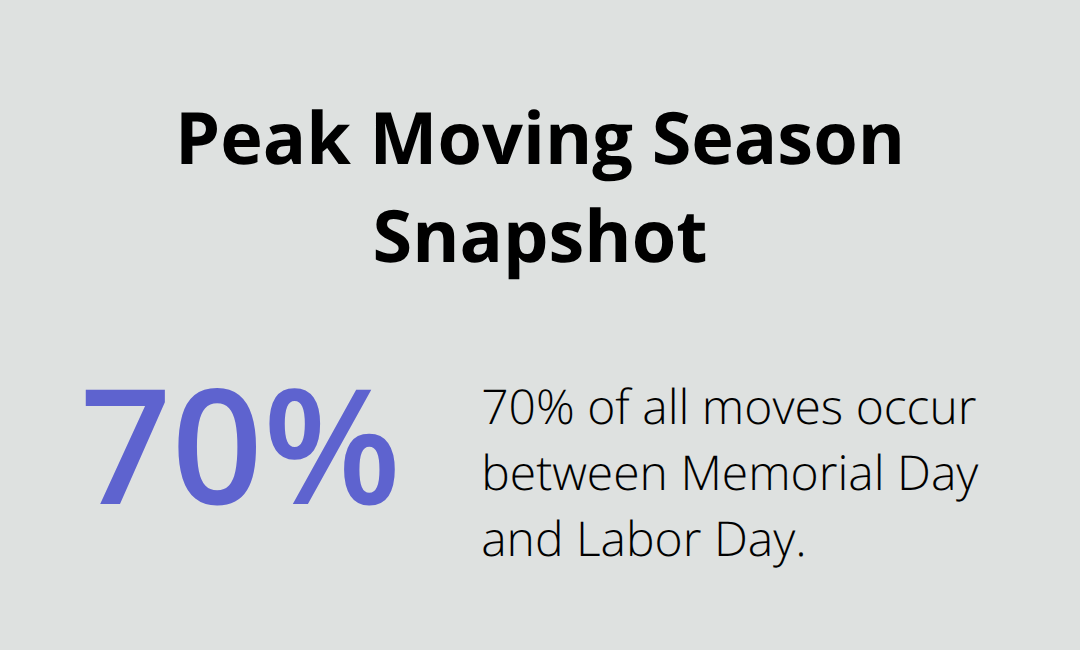
Moves between May and September cost 20 to 30 percent more than winter relocations because roughly 70 percent of all moves occur between Memorial Day and Labor Day.
Within that peak season, weekends cost substantially more than weekday moves. Mid-week, mid-month bookings often run 10 to 20 percent cheaper than Friday-to-Sunday relocations. Some movers offer guaranteed pickup dates, which adds 25 to 50 percent to your bill. Expedited delivery carries the same markup.
Packing and Storage Multiply Your Total Expense
Packing services multiply your costs significantly. Full-service packing for a 2,000-square-foot home runs $1,000 to $2,000 in labor alone, plus another $500 to $1,000 for materials. Professional packers typically charge $40 to $60 per hour per person, and most jobs require two to three people. Packing materials themselves carry heavy markups-boxes cost $3 to $5 each, wardrobe boxes $20 to $40, and tape $7 to $10 per roll.
Storage adds another layer. Overnight truck storage runs $100 to $200; warehouse storage costs $50 to $150 monthly per vault. These expenses stack fast for moves involving delays or phased relocations. Insurance choices matter financially. Basic valuation protection costs nothing but covers only $0.60 per pound per item. Full-value protection, which covers repair or replacement at current market value, typically runs $100 to $500 depending on your inventory’s total declared value.
Understanding these cost drivers helps you anticipate what your move will actually cost. The next section breaks down typical price ranges for different move types so you can start narrowing your budget.
What You’ll Actually Pay for Your Move
Local Moves: Hourly Rates and Hidden Minimums
Local moves within 50 miles typically run $260 to $1,495, with most two- to three-bedroom homes landing around $1,250. That hourly rate of $108 to $125 per hour for two movers and a truck sounds straightforward until you factor in the two- to three-hour minimum that applies regardless of how quickly your job finishes. A studio apartment might take 90 minutes of actual work, but you still pay for three hours. In expensive metro areas, hourly rates exceed $200, which compounds fast.
Labor-only moves offer a genuine alternative if you’re willing to rent your own truck. Two movers for four hours typically costs around $424 to $500, then add truck rental at $30 to $150 daily. This approach saves 40 to 60 percent compared to full-service pricing, though you sacrifice convenience and professional equipment.
Long-Distance Moves: Weight and Mileage Rule Pricing
Long-distance moves operate on completely different economics. A 1,000-mile relocation for a two- to three-bedroom home averages $2,500 to $4,900, priced at roughly $0.50 to $0.70 per pound of your belongings. A typical 2,500-mile cross-country move for the same home size easily exceeds $10,000.
Movers base the cost of your move on the total weight of your shipment along with the distance of your move. A 5,000-pound load travels the same distance as a 7,500-pound load, but your bill reflects that 2,500-pound difference directly. This weight-based model means you control one major cost variable: how much you pack into the truck.
Specialty Items and Complex Logistics
Specialty moves command premiums that surprise most people. Piano relocations locally cost $150 to $600; add crane assistance and cross-country distance, and expect $2,500 or more. Gun safes run $100 to $500.
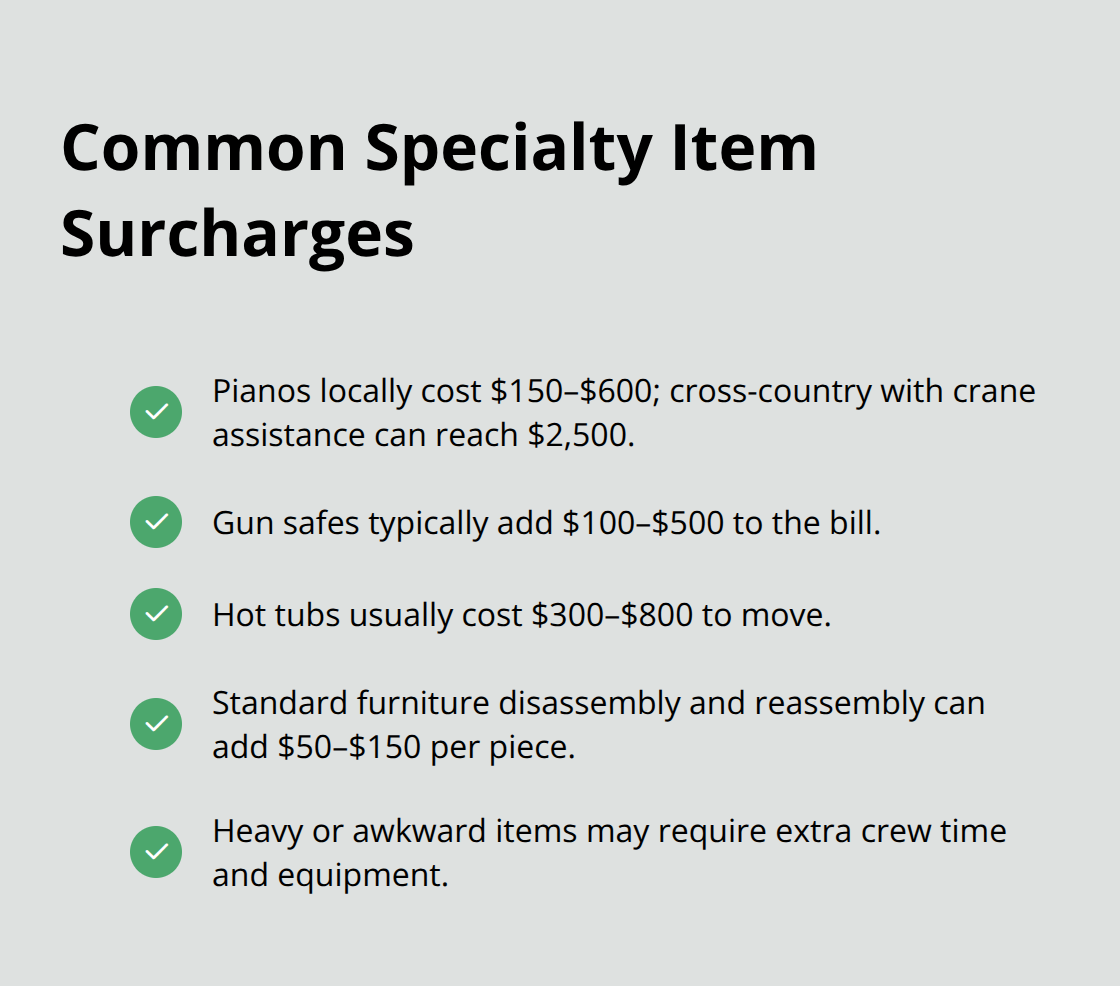
Hot tubs cost $300 to $800. These aren’t negotiable add-ons; they reflect genuine safety and handling requirements.
Standard commercial relocations follow similar weight-based pricing as long-distance residential moves but often include additional coordination time, phased delivery schedules, and equipment positioning that inflate the final cost. The complexity multiplies when you add multiple stops, tight building access, or items requiring specialized handling (pianos, artwork, antiques).
Getting Accurate Quotes for Your Specific Move
If your move involves specialty items or complex logistics, obtaining quotes from at least three licensed movers provides the only realistic way to predict your actual expense. Each mover will assess your specific situation-the actual weight, access challenges, and any specialty items-and generate a customized price. This comparison process reveals which movers understand your move’s true scope and which ones underestimate costs to win your business.
How to Cut Your Moving Costs Without Sacrificing Quality
Downsize Your Load to Slash Long-Distance Expenses
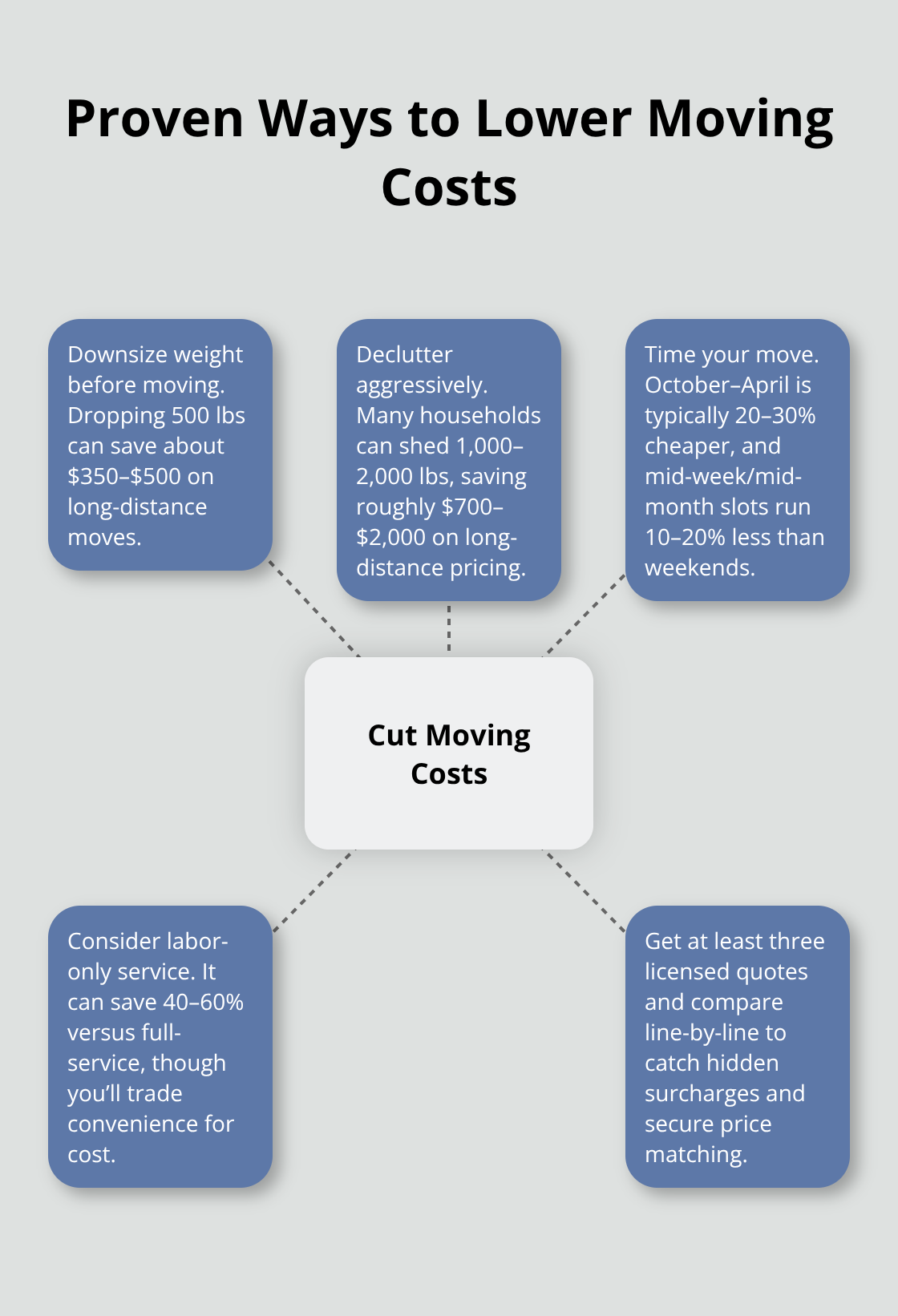
Reducing your moving expenses requires aggressive action on the variables you control. The most effective cost-cutting strategy is downsizing your load before the truck arrives. Removing 500 pounds from a long-distance move saves approximately $350 to $500 since professional movers typically charge $0.70 to $1.00 per pound. Go through your home systematically and sell, donate, or discard items you haven’t used in two years. Every pound you eliminate directly reduces your bill.
For local moves charged hourly, a lighter load means fewer hours of labor, which compounds your savings. Many people discover they can eliminate 1,000 to 2,000 pounds through honest decluttering, which translates to $700 to $2,000 in avoided costs on long-distance relocations. This isn’t theoretical advice-the math is straightforward and immediate.
Move During Off-Peak Months for Maximum Savings
Timing your move outside peak season delivers the second-largest savings. Moving between October and April costs 20 to 30 percent less than May through September relocations because roughly 40–45% of all moves happen between May and August. Within off-peak seasons, mid-week and mid-month bookings run 10 to 20 percent cheaper than Friday-to-Sunday slots.
A two-bedroom local move averaging $1,250 during peak season might cost $875 to $1,000 in winter. Long-distance moves show even starker differences-a $4,000 summer relocation could drop to $2,800 to $3,200 in winter months. The movers have availability, so they compete harder on pricing.
Compare Itemized Quotes Line-by-Line
Getting multiple quotes from at least three licensed carriers reveals which companies offer genuine discounts versus which ones inflate off-season pricing. Compare itemized estimates line-by-line because some movers hide surcharges in vague categories. Request explicit pricing for packing materials, travel fees, fuel surcharges, and any specialty item handling.
One mover might charge $50 per hour while another charges $60 but includes equipment and blankets in their base rate.
The detailed comparison exposes these differences. Ask each mover directly whether they offer price matching if you find a lower legitimate quote, since many carriers will match competing bids rather than lose your business. You control the final decision, and movers know that obtaining three separate estimates takes time and effort.
Final Thoughts
Moving company pricing reflects the choices you make about timing, load size, and service level. Downsize your belongings before the truck arrives, move during off-peak months from October through April, and obtain itemized quotes from at least three licensed carriers to unlock savings of $1,000 to $3,000 on most residential relocations. Professional movers deliver genuine value beyond transportation-they handle specialty items safely, navigate access challenges efficiently, and carry insurance that protects your belongings against damage.
We at Southbay Moving Systems understand that moving company pricing can feel overwhelming without clear guidance. Your final bill reflects the decisions you make today about when you move, what you pack, and which services you select. Understanding these cost factors positions you to negotiate effectively and stay within budget.