

Commercial office moves demand careful planning to protect your bottom line and keep your team productive. At Southbay Moving Systems, we’ve helped dozens of businesses navigate this challenge without losing momentum.
The difference between a chaotic relocation and a seamless one comes down to strategy. This guide walks you through the essential steps to make your transition work.
Setting the Foundation for Your Move
Measure your actual space needs against your current footprint, then add 15–20% for growth over the next three to five years. Most companies underestimate this number and end up cramped within two years. Sit down with department heads to understand how teams work now and how they’ll work in your new location. Open floor plans sound modern, but if your engineering team needs focus time, forcing them into a high-traffic zone tanks productivity. Your timeline matters just as much. Start the search and lease negotiation six to twelve months before your move date. This gives you room to negotiate tenant improvement allowances, coordinate IT infrastructure upgrades, and avoid the panic of rushing decisions. A tech startup moved from WeWork to a dedicated 5,000 square foot space in May 2025 and reduced moving-day confusion by 60% because they started planning nine months ahead.
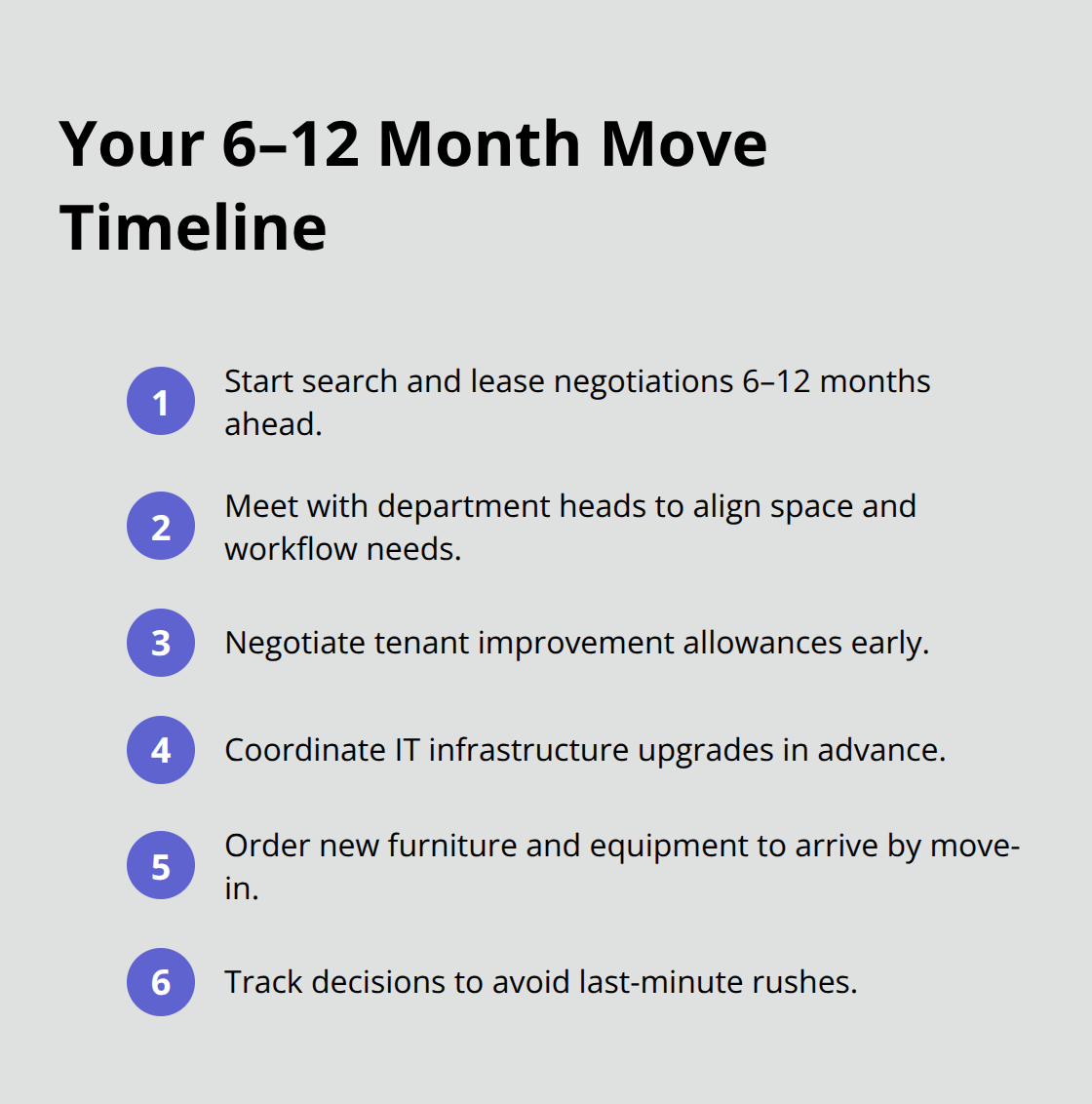
They hit the ground running in five days instead of the projected ten.
Budget Reality and Asset Tracking
Build a budget that accounts for more than just movers. Rent deposits, design fees, IT reconfigurations, downtime, and furniture replacements add up fast. Include a 10–15% contingency because something always costs more than expected. Track spending by category so you can see where money actually goes. Downtime itself carries real cost-if your team loses four days of productivity, that’s money gone. Before you pack a single box, take a complete inventory of what you own. Photograph furniture and equipment, note condition, and decide what stays and what goes. Donating usable items to nonprofits beats paying to move things you’ll replace anyway. Order new furniture and equipment early so it arrives on or before moving day, not weeks after. This prevents the frustration of employees setting up makeshift workstations while waiting for chairs and desks.
Stakeholder Notifications
Communicate the new address to vendors, clients, and external stakeholders at least four weeks before the move. Update your website, email signatures, and directory listings so nothing falls through the cracks. This step prevents costly missed connections and maintains client confidence during your transition.
The Communication Plan That Actually Works
Tell your team the move is happening before rumors do the job for you. Share the new address, the move date, and most importantly, why the move benefits them. Better light, shorter commutes, more collaboration space-whatever the real advantages are (these details matter to staff morale). Hold brief update meetings every two weeks leading up to the move so people feel informed, not blindsided. Anxiety kills morale, but transparency builds it. Create a single communication hub-a shared document, email, or intranet page-where employees find FAQs, timelines, contact information, and parking details for the new location. This prevents the same questions from hitting your inbox fifty times. Assign one person as the move coordinator. That person owns the schedule, answers questions, and tracks progress. When people know who to ask, confusion drops dramatically. With your foundation solid and your team aligned, the next step focuses on the logistics that keep your operation running smoothly during the actual relocation.
How to Keep Your Business Running During the Move
Schedule Your Move for Maximum Efficiency
Timing your move strategically makes the difference between a minor hiccup and a business crisis. Schedule the relocation for late Friday through the following Monday or Tuesday when most teams operate at reduced capacity anyway. Moving mid-week forces you to coordinate around active work schedules, which tanks productivity and stretches the timeline. A weekend move also gives your IT team uninterrupted time to test systems and resolve connectivity issues before staff returns on Monday morning.
If your business operates around the clock or serves clients across time zones, coordinate with department heads to identify the absolute slowest period in your calendar. Some companies find success moving during the final week of a quarter or during a planned shutdown period. The goal is simple: minimize the number of working hours your team loses to the relocation itself.
Prepare Your IT Infrastructure Before Moving Day
Before movers arrive, your IT infrastructure must be ready at the new location. This means running network cables, setting up server rooms, configuring phone systems, and testing internet connectivity days before furniture arrives. Too many companies treat IT as an afterthought and discover on moving day that their connection is spotty or their phones don’t work.
Conduct a full audit of every IT asset at least six weeks before the move, then label and photograph equipment for tracking. Back up all critical data and decommission sensitive systems in the correct order to protect information security. Have your IT team arrive at the new space 48 hours before general movers to validate that utilities work, network infrastructure is live, and systems respond as expected. Test workstation connectivity, printer networks, and access control systems with actual equipment before employees need them.
Establish Clear Roles and Responsibilities on Moving Day
Assign clear roles on moving day itself: one person oversees furniture placement, another manages IT equipment setup, a third tracks incoming boxes against your inventory, and a fourth handles vendor coordination. When responsibilities overlap or remain undefined, chaos follows. Create a detailed moving day checklist and distribute it to everyone involved at least one week in advance.
Use color-coded asset tags so movers can match items to their destinations without confusion. Stagger employee arrival times so not everyone shows up at 8 a.m. expecting to find their desk ready. Bring in your IT and facilities teams 2–3 hours before staff to troubleshoot any last-minute issues. A tech startup that moved in May 2025 succeeded partly because they assigned one person to stand at the new location entrance and direct movers to each department’s zone, reducing placement errors by 70%.
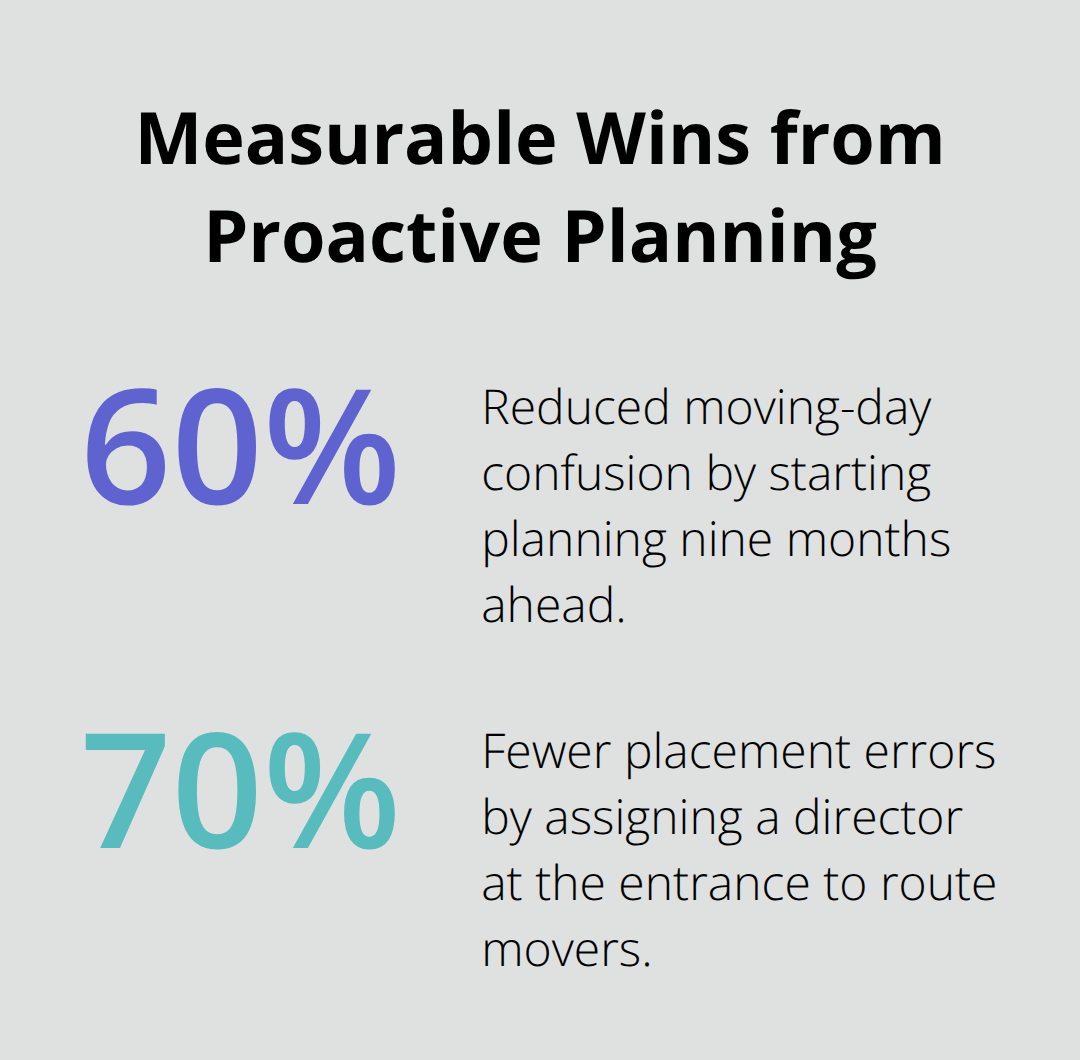
This single decision prevented hours of rearranging furniture after the fact.
With your move logistics locked in and your team positioned for success on moving day, the next challenge focuses on what happens after the boxes are unpacked and your staff settles into their new workspace.
How to Keep Your Team Engaged During the Move
Communicate with Clarity and Consistency
Your employees watch the move closely, and their perception of the transition directly affects how quickly they return to full productivity. Transparency stops rumors cold. Announce the relocation as early as possible and provide details about the timeline, reasons for the move, and how it will impact daily operations. Include specific details about parking arrangements at the new location and what time employees should arrive that day.
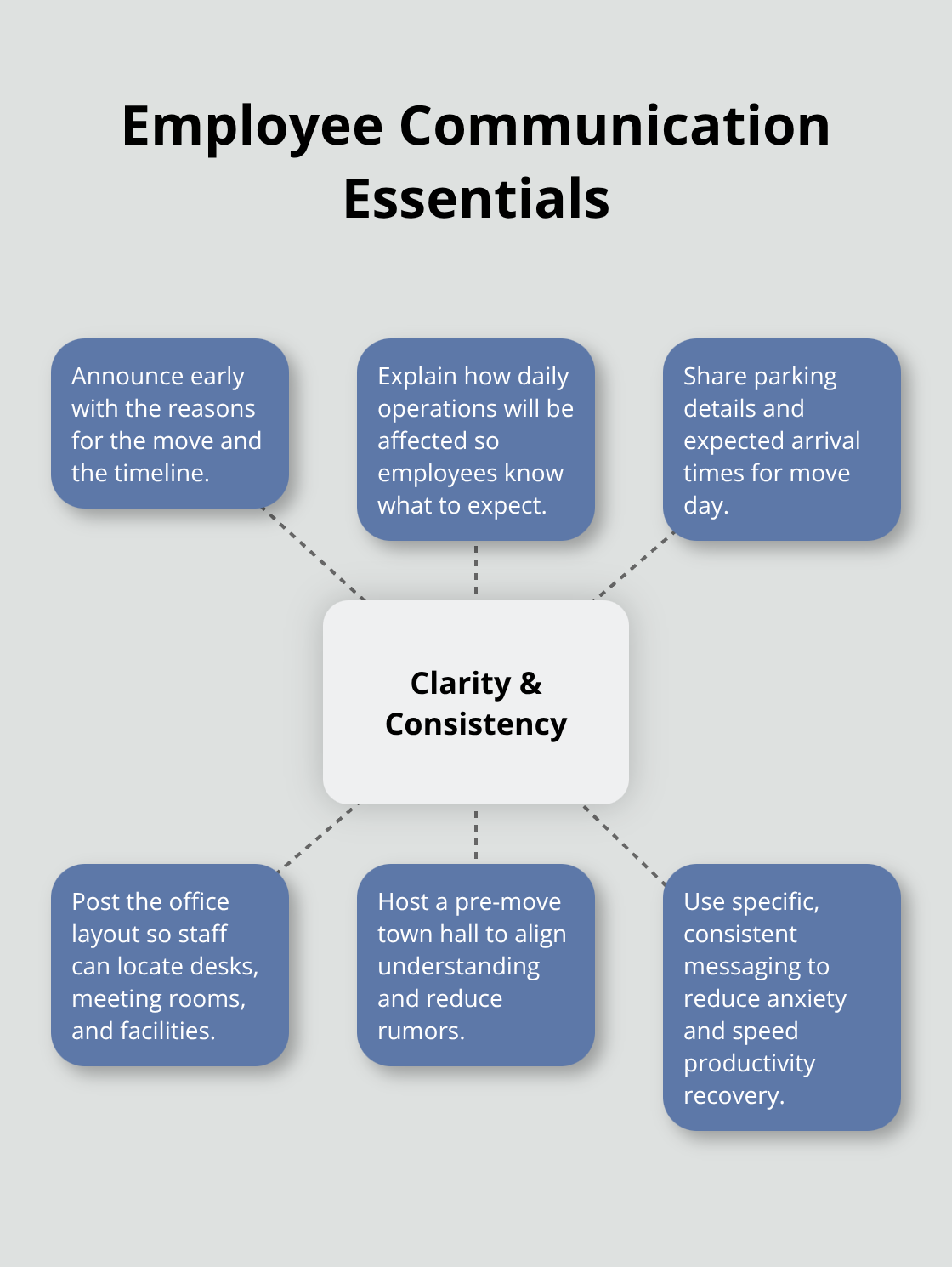
Vague announcements create anxiety. People accept change far more readily when they understand what’s happening and why.
Help Employees Navigate the New Space
Post the new office layout online so employees can locate their desk, meeting rooms, and facilities before they walk through the door. Nothing kills momentum faster than staff spending their first day hunting for the bathroom or their assigned workspace. Hold a town hall before the move where leadership explains the business reasons behind the relocation, how the new space supports company growth, and what happens on moving day itself. This single meeting prevents dozens of individual conversations and ensures everyone hears the same message.
Support Staff Through Personal Disruptions
Some employees struggle more than others with the disruption. Identify staff who have longer commutes to the new location or who rely heavily on established routines and check in with them directly. Offer flexible work arrangements for the first two weeks post-move so people can handle personal logistics without falling behind on work. One team member might need to adjust childcare, another might lose their carpool arrangement. These aren’t small issues to the people experiencing them. Acknowledge the difficulty openly rather than pretending the move is seamless for everyone.
Mark the Transition as a Growth Milestone
Schedule a celebration event within the first week after settling in, not months later. Invite employees to tour the new space together, serve food, and let people see where their colleagues now sit. This transforms the move from a logistical headache into a growth milestone. The event doesn’t need to be expensive, but it should mark the transition as a positive step forward. Teams that skip this celebration miss a chance to build momentum and reset morale after weeks of disruption.
Final Thoughts
A successful commercial office move hinges on three core elements: planning that starts months ahead, clear communication that keeps anxiety at bay, and execution that minimizes disruption. The companies that move smoothly aren’t the ones with unlimited budgets or perfect timing-they’re the ones that assign ownership, track details, and treat the relocation as a business project rather than a logistical afterthought. Your takeaway is straightforward: start planning six to twelve months before your move date, build a realistic budget with a 10–15% contingency, and communicate early and often with your team, vendors, and clients.
Professional movers handle the physical work, but your internal team drives the success. We at Southbay Moving Systems understand this distinction and have supported commercial relocations of all sizes throughout Central California with customized services, transparent pricing, and the logistics expertise that keeps your operation running. Our team manages the heavy lifting so your staff can focus on business continuity rather than moving day logistics.
Review your current lease end date and identify your target move window. Assess your space needs against your growth projections. Reach out to Southbay Moving Systems for a consultation and quote tailored to your business, and let a professional moving partner remove uncertainty while your internal team handles what matters most.