
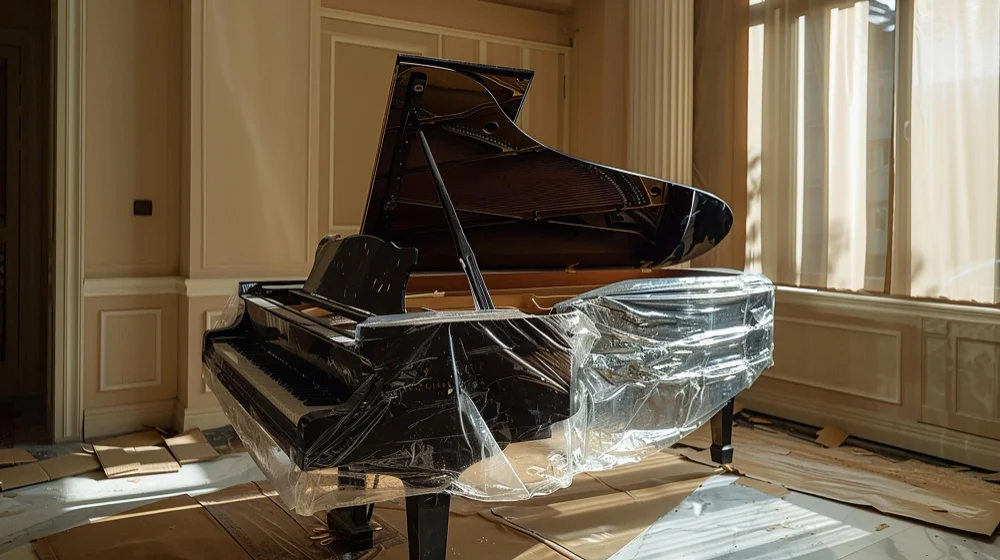
Ask anyone who has tried to slide an old upright across a living room and they’ll tell you the same thing: it’s heavier than it looks. So how much does a piano weigh? Most acoustic pianos weigh between about 300 and 1,100 pounds. A small console sits near the bottom of that range, a full-size upright lands around 500 to 650 pounds, and a nine-foot concert grand tops 1,000 pounds.
We get this question all the time from people planning a move, and for good reason. The weight decides how many people you need, what equipment comes along, and whether the stairs are going to be a problem. Our piano movers work from Salinas across the Monterey Bay, the Salinas Valley, San Jose and the Central Valley, and this guide covers what each type of piano typically weighs and what that means on moving day.

How Much Does a Piano Weigh by Type?
Every model is a little different, so treat these as rounded, typical ranges. Heights apply to uprights (floor to top of the case). Lengths apply to grands (keyboard to the tail).
| Piano type | Typical height or length | Typical weight range |
|---|---|---|
| Spinet | 36 to 40 in. tall | About 250 to 400 lbs |
| Console | 40 to 44 in. tall | About 350 to 450 lbs |
| Studio upright | 44 to 48 in. tall | About 400 to 525 lbs |
| Full-size (professional) upright | 48 to 52+ in. tall | About 500 to 700 lbs |
| Baby grand | About 4 ft 11 in. to 5 ft 7 in. long | About 550 to 650 lbs |
| Parlor or living room grand | About 5 ft 8 in. to 6 ft 4 in. long | About 650 to 800 lbs |
| Semi-concert grand | About 6 ft 5 in. to 7 ft 6 in. long | About 800 to 950 lbs |
| Concert grand | About 9 ft long | About 1,000 to 1,100 lbs |
| Digital piano (cabinet style) | Similar footprint to a console | About 80 to 200 lbs |
Those ranges line up with published manufacturer specs. Yamaha lists its 48-inch U1 upright at 502 lbs and its 52-inch U3 at 517 lbs on its U Series spec sheet. Steinway’s 52-inch K-52 upright is listed at 650 lbs. On the grand side, Yamaha’s grand piano size comparison runs from 574 lbs for the five-foot GB1K to 1,069 lbs for the nine-foot CFX, and Steinway lists its Model D concert grand at 1,064 lbs.
Spinets are the one category where specs are hard to pin down. Most are older instruments that are no longer made, so weights vary more than with current models. If yours has a model number, a quick search for its spec sheet beats any chart.
How Much Does an Upright Piano Weigh?
Height is the quickest clue. The taller the upright, the longer the strings, the bigger the iron plate, and the heavier the piano. A 43-inch console is often under 400 lbs. A 48-inch upright is usually around 500 lbs, and a 52-inch professional upright can reach 650 lbs or more. Old full-size uprights from the early 1900s are often the heaviest of all, with thick solid-wood cases.
How Much Does a Baby Grand or Grand Piano Weigh?
Length works the same way for grands. A baby grand around five feet long weighs roughly 550 to 650 lbs. Steinway’s Model S, at 5 feet 1 inch, is listed at 579 lbs. Step up to a six-foot living room grand and you’re in the 700 lb range. Semi-concert grands push past 800 lbs, and full concert grands clear half a ton.
What About Digital Pianos?
Digital pianos have no strings or iron plate, so they’re much lighter. A portable keyboard is light enough for one person to carry. A home digital piano in a furniture-style cabinet usually weighs about 80 to 200 lbs, which two people can usually handle with care. They still need padding and an upright position in the truck, and our guide on shipping a digital piano safely covers the packing side.
Why Are Pianos So Heavy?
Most of the weight comes from parts you never see.
- The cast-iron plate. This is the gold-colored frame inside the case. Steinway says up to 20 tons of string tension pulls on a piano at all times, and the plate is what keeps it from folding in on itself. It’s often the single heaviest part.
- More than 200 steel strings. Most notes use two or three strings, each pulled tight. The tension is why the plate has to be so massive.
- Hardwood case and bracing. Rims, back posts and braces are built from dense woods like maple and spruce so the piano holds its shape for decades.
- The soundboard, keys and action. Thousands of small wooden and felt parts add up, along with the keybed and pedals.
Where the Weight Sits in a Piano
Piano weight isn’t spread evenly, and that matters more than the number on a scale.
An upright is tall, narrow and top-heavy. The iron plate and strings sit high in the back of the case, so it can tip forward or backward if it’s tilted too far. Most uprights have small casters, but those are meant for nudging the piano along a wall, not rolling it across a room or over a threshold.
A grand is a different job. Its weight rests on three legs, and the long case is heavier toward the keyboard end, where the plate and action sit. For a move, our crews remove the legs and pedal lyre, wrap the body in moving blankets, and strap it on its side to a padded piano board. The piano board is what turns an awkward 700 lb shape into something a crew can control.
Can Two People Lift an Upright Piano?
Honestly, they shouldn’t. Even a small console weighs as much as two or three adults, and the weight sits high and off-center. Two people trying to lift an upright are fighting the piano’s balance the whole time.
- Injury risk. Back strains and crushed fingers or feet are the common ones. A piano that tips can pin someone against a wall or a stair rail.
- Damage to the piano. Uprights aren’t built to be lifted by the case. Grabbing the wrong spot can crack a leg, snap a key slip or knock the action out of alignment.
- Damage to the house. A dropped corner gouges hardwood, and a piano rolled on its own casters can dent floors and tear vinyl.
Our guide on how to transport a piano safely walks through the right equipment and steps if you want to see what a proper move looks like.
What Piano Weight Means for Your Move
When you ask for a quote, the piano’s type and size are the first things a mover will want to know. Here’s why:
- Stairs. Every step adds risk and time. Movers ask how many steps, whether there are landings, and how tight the turns are.
- Floor protection. Hundreds of pounds on a dolly wheel can mark wood, tile and carpet. Expect runners or padded floor coverings along the path.
- Ramps and liftgates. Pianos go into the truck on a ramp or liftgate rather than being carried up by hand. Porch steps and steep driveways can change the plan.
- The truck. The piano is strapped upright (or on its board for a grand) against the truck wall so it can’t shift.
- Crew size. Heavier pianos and harder paths mean more people. A ground-floor console is a very different job from a semi-concert grand going down a flight of stairs.
Cost follows weight and difficulty, too. For more on pricing factors, see our breakdown of what a piano moving company costs. If you’re comparing movers, our checklist on choosing a moving company for piano transport lists the questions worth asking.
Piano Weight FAQ
How heavy is a full-size upright piano?
A full-size upright, about 48 to 52 inches tall, usually weighs around 500 to 700 lbs. Yamaha’s 48-inch U1 is listed at 502 lbs and Steinway’s 52-inch K-52 at 650 lbs. Older uprights with heavy wooden cases can weigh more.
Can two people lift an upright piano?
It’s not safe. Even small uprights weigh several hundred pounds, and the weight sits high in the case, so they tip easily. Movers use piano dollies, straps, ramps and a larger crew instead of lifting by hand.
How much does a baby grand piano weigh?
Most baby grands weigh about 550 to 650 lbs. Steinway lists its 5-foot-1 Model S at 579 lbs, and Yamaha lists its 5-foot GB1K at 574 lbs.
How much does a concert grand piano weigh?
A nine-foot concert grand weighs about 1,000 to 1,100 lbs. Steinway’s Model D is listed at 1,064 lbs and Yamaha’s CFX at 1,069 lbs.
Do digital pianos need professional movers?
Not always. Most cabinet-style digital pianos weigh 80 to 200 lbs, so two careful people can usually move one. For long hauls or stairs, padding and a mover still help, especially if it’s part of a bigger long-distance move.
Moving a Piano in Central California?
Whether it’s a 400 lb console in a Salinas bungalow or a grand on the second floor in San Jose, our piano moving team brings the boards, dollies, straps and ramps the job needs. Request a free piano moving estimate online or call us at 866-462-3443. Moving pianos for Central California families since 1991, South Bay Moving Systems is ready when you are.